

Pressure Washer Buying Guide: Bar Pressure, LPM & Motor Type Explained
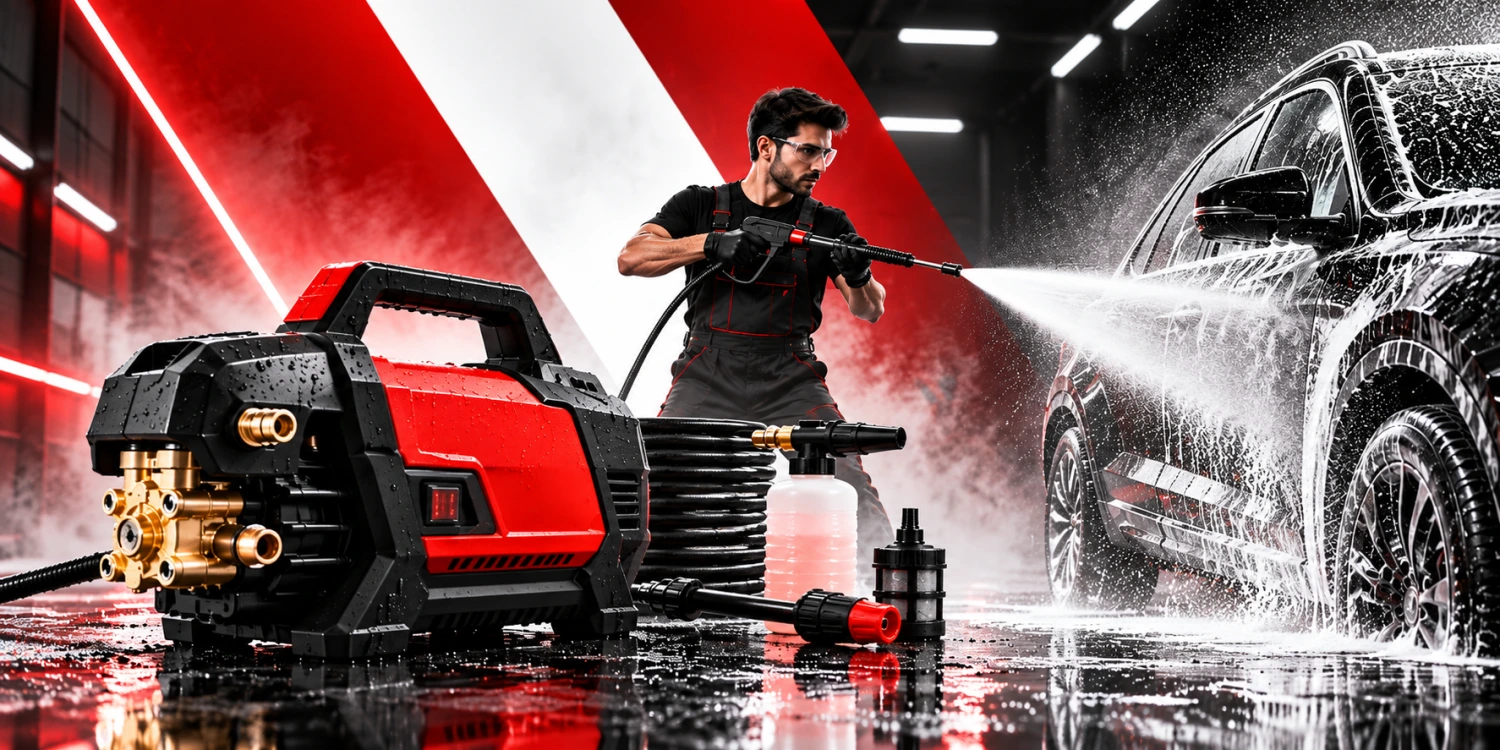
A pressure washer turns a slow bucket-and-sponge job into a five-minute one — but only if you buy the right one. Too little bar pressure and it barely cuts through mud; too little flow rate and it takes forever to rinse; the wrong motor and it won't survive a monsoon-season of driveway cleaning. This guide covers what the spec sheet numbers actually mean, how to match a machine to your job, and how our own SHAKTI lineup — S3, S5, S7 Pro and S5 Pro — compares on paper, so you can pick by what you need rather than by guesswork.
What a pressure washer actually does
A pressure washer takes ordinary tap-pressure water, pulls it through an electric motor-driven pump, and forces it out through a narrow nozzle at high velocity. The result is water moving fast enough to physically dislodge dirt, grease and grime rather than just dissolving it — which is why a 10-minute pressure wash often outperforms 30 minutes of bucket washing, and uses less water doing it.
Three numbers on the box decide how well a machine does that job: bar pressure, flow rate, and motor power. Get familiar with these before you compare models — they matter far more than brand name or looks.
Bar pressure: what it means and how much you need
Bar (sometimes shown as PSI — 1 bar ≈ 14.5 PSI) measures how hard the water hits the surface. Higher bar means more cutting force against caked-on dirt, but it also means more risk of damaging soft surfaces like car paint or wood if used carelessly from too close.
| Bar rating | Good for | Avoid on |
|---|---|---|
| 90–120 bar | Cars, bikes, scooters, garden furniture, light home cleaning | Thick oil stains, deep-set driveway grime |
| 120–135 bar | Driveways, courtyards, two-wheeler fleets, semi-regular heavy use | Delicate painted surfaces at close range |
| 135+ bar | Commercial/semi-professional cleaning, workshops, stubborn stains | Anything where you're not controlling spray distance carefully |
For a car or bike washed at home every week or two, 120–125 bar is the practical sweet spot — enough to cut through road grime without needing to hold the nozzle dangerously close to the paint.
Flow rate (LPM): the number buyers usually skip
Flow rate — litres per minute (LPM) — decides how fast the machine rinses a surface clean once the pressure has loosened the dirt. A high-bar, low-LPM machine can cut grime effectively but then take much longer to actually wash it away, because there isn't enough water volume moving through. For home and light-commercial use, 6–8 LPM is a realistic, efficient range — enough to rinse a car or a courtyard without needing an oversized pump.
Motor type: induction vs universal
Most home-use electric pressure washers use either an induction motor or a universal (brushed) motor.
- Induction motors run cooler, last longer under repeated use, and are quieter — the trade-off is usually a slightly heavier unit. This is what you want if you're washing multiple vehicles weekly or running the machine for 20+ minutes at a stretch.
- Universal motors are lighter and cheaper to make, spin faster for a given size, but generate more heat and wear faster under sustained, heavy-duty use. Fine for occasional, short cleaning sessions.
A machine built around a 100% copper winding motor (rather than copper-clad aluminium) is a genuine durability signal — copper handles heat and sustained current far better, which is why it shows up as a selling point on heavier-duty models.
Corded electric vs petrol: why electric wins for most homes
Pressure washers broadly split into two power types — corded electric and petrol-engine. Every machine in our range is corded electric, and for good reason: it's the right choice for the vast majority of home and light-commercial use in India.
| Factor | Electric | Petrol |
|---|---|---|
| Running cost | Just electricity — a few rupees per wash | Petrol, plus periodic engine servicing |
| Noise | Quiet enough for apartment complexes and early-morning use | Loud — a real constraint in residential societies |
| Maintenance | Minimal — no oil changes, no spark plugs, no carburettor issues | Needs regular engine maintenance like any small combustion engine |
| Fumes/emissions | None — safe for indoor garages and basements | Exhaust fumes — must be used outdoors or well-ventilated |
| Portability | Limited by cable/outlet reach | Fully mobile, no power point needed |
| Typical use case | Homes, societies, workshops, retail/commercial premises with power access | Farms, remote sites, large outdoor areas with no nearby power point |
Unless you're cleaning somewhere with no electricity access at all — a farm, a construction site, a remote property — electric is simpler, cheaper to run, and easier to live with day to day. The one planning point is cable and hose reach: check your outlet location against the area you need to clean before you buy, since extension cords for high-power motors need to be correctly rated (thick enough gauge, not a long thin phone-charger-style cable) to avoid voltage drop or overheating.
Water source and setup: what you need before you start
A pressure washer needs a steady water supply to work safely — running the pump dry, even for a few seconds, can damage the seals. Before buying, think through where your water will come from:
- Direct tap connection — the simplest setup. Most home-use machines connect straight to a standard garden tap via the inlet hose. Check your tap's water pressure is adequate; most municipal and borewell supplies are fine.
- Bucket or drum draw (self-priming) — useful where there's no tap nearby, or where tap pressure is unreliable. Only self-priming models can do this — check the spec before assuming any machine can pull from a static source.
- Overhead tank feed — gravity-fed tank water works for most machines, though very low head pressure can occasionally cause intermittent suction issues; a direct tap line is more reliable if available.
Also plan your power point: a nearby 15A or 16A socket is standard for machines in the 1800–2000W range. Running a high-wattage motor off a long, thin extension cord shared with other appliances is a common, avoidable cause of tripped circuits and underperforming machines.
Accessories that actually matter
The machine is half the story — the gun, lance, nozzle and hose decide how usable it is day to day.
| Accessory | What it's for |
|---|---|
| Adjustable nozzle (narrow jet ↔ wide fan) | Narrow jet for cutting through caked mud; wide fan for rinsing large flat areas without streaking |
| Foam/soap dispenser bottle | Pre-wash foam coating loosens dirt before the jet hits it — reduces the chance of paint-swirl marks on cars |
| Extension/outlet hose length | An 8-metre hose reaches around a car or small courtyard without having to move the machine mid-wash |
| Self-priming / bucket-draw capability | Lets the machine pull water directly from a drum or bucket where there's no continuous tap line nearby |
| Auto-stop function | Motor stops the moment you release the trigger — saves power and extends pump/motor life versus running idle |
Matching a machine to your actual job
Occasional home use — one or two vehicles, weekly or fortnightly wash: A compact, lightweight unit in the 90–120 bar range is enough. You're optimising for ease of storage and low cost of entry, not raw power.
Regular home use — multiple vehicles, driveway, garden furniture, outdoor walls: Step up to 120–125 bar with a higher flow rate (8 LPM). The extra pressure and volume cut cleaning time noticeably on larger areas, and a heavier-duty motor copes better with longer run times.
Housing societies / RWA shared use: If the machine will be used by multiple residents across the week for cars, two-wheelers and common-area cleaning, treat it like semi-professional use even if no single person runs it for long — cumulative daily use adds up faster than occasional personal use, and a heavier-duty motor avoids early burnout.
Two-wheeler service points and small garages: Where the job is mostly bikes and scooters rather than cars, a mid-range machine (120–125 bar, 6–8 LPM) is usually sufficient — two-wheelers have far less surface area and less baked-on underbody grime than a car's chassis.
Semi-professional or workshop use — frequent, longer sessions, tougher grime: Prioritise motor build quality (copper winding, induction type) and a heavier chassis over just the bar number. A machine built to run for an hour without overheating is worth more here than a few extra bar on the spec sheet.
Getting the technique right: a basic wash routine
Buying the right machine is half the job — using it correctly protects both the surface you're cleaning and the machine itself.
- Rinse first with a wide fan nozzle to knock off loose dust and grit before applying any soap — this prevents loose particles from being dragged across the paint and causing fine scratches.
- Apply foam or soap from the bottom up using a foam cannon or dispenser bottle attachment, and let it sit for the time specified on the product (usually a few minutes) to loosen grime chemically before you blast it off.
- Rinse from top to bottom with the jet nozzle, keeping a consistent distance (start at roughly 30–40 cm for a car and move closer only if needed) and moving in overlapping passes rather than lingering on one spot.
- Finish with a final wide-fan rinse to clear any remaining suds, then dry with a microfibre cloth to avoid water-spotting, especially with hard water.
This is the same basic routine professional detailers use, scaled down for home equipment — the two-step rinse (wide fan, then targeted jet, then wide fan again) does far more to protect paint than nozzle choice alone.
Comparing the Tools Tribe pressure washer range
Here's how our four current models stack up on the numbers that matter, so you can match spec to budget instead of guessing from the name alone.
| Model | Price | Motor | Pressure | Flow rate | Best for |
|---|---|---|---|---|---|
| SHAKTI S3 | ₹4,838 | 1800W | 120 Bar | 6 LPM | Entry-level home use — one or two vehicles, occasional wash |
| SHAKTI S5 | ₹7,100 | 1900W induction | 125 Bar | 8 LPM | Regular home use — multiple vehicles, driveways, garden furniture |
| SHAKTI S7 Pro | ₹8,990 | 100% copper winding | Heavy-duty rated | — | Deep cleaning of vehicles, driveways and domestic surfaces where motor longevity under repeated use matters most |
| SHAKTI S5 Pro | ₹10,300 | 1900W induction | 125 Bar | 8 LPM | Semi-professional use — same core pressure/flow as the S5, built on a significantly heavier 21 kg chassis for sustained duty cycles |
Note on the S5 vs S5 Pro: both share the same 1900W / 125 bar / 8 LPM core numbers. The Pro's price step comes from its far heavier 21 kg build (against the standard S5's 3 kg) — a sturdier chassis and components built for longer, more frequent runs rather than a different pressure spec.
Safety checks before every wash
| Check | Why it matters |
|---|---|
| Plug point is on an RCD/ELCB-protected circuit | You're combining mains electricity and water — a residual current device is non-negotiable, not optional |
| Hose and cable inspected for cuts or abrasion | A damaged pressure hose can fail suddenly under load; a damaged power cable is a shock risk around water |
| Nozzle distance tested on an inconspicuous spot first | 120+ bar at close range can chip paint or strip wood finish — always start further away and move in |
| Never point the jet at yourself, pets or bystanders | High-pressure water at this range can break skin, not just clean surfaces |
| Machine switched off and depressurised before disconnecting hose | Residual pressure in the line can cause a sudden spray of water on disconnection |
Maintenance that extends the machine's life
- Flush after use with hard or muddy water — mineral deposits and grit left in the pump wear seals faster than normal use does.
- Store coiled, not kinked — a sharply bent hose develops weak points that eventually crack under pressure.
- Keep the inlet filter clean if you're drawing water from a bucket or drum — unfiltered debris is the most common cause of a clogged nozzle or a damaged pump.
- Don't run dry — operating the pump with no water supply, even briefly, is one of the fastest ways to damage the seals and shorten motor life.
Common mistakes first-time buyers make
Buying on bar rating alone. A high-bar, low-flow machine cuts dirt well but rinses slowly — flow rate matters just as much for how long the job actually takes.
Ignoring motor type for the sake of a lower price. A universal-motor unit run for long sessions regularly will wear out faster than an induction-motor machine built for sustained use — the cheaper machine can end up costing more in replacements.
Skipping the accessory check. A machine with no adjustable nozzle or a short stock hose often needs accessories bought separately almost immediately — factor that into the real cost before comparing prices.
Using it like a garden hose. A pressure washer concentrates far more force into a smaller area than a hose ever does — surfaces that seem tough (old paint, soft wood, car decals) can be damaged by someone used to hose-pressure habits.
Quick glossary: spec-sheet terms explained
| Term | What it means |
|---|---|
| Bar / PSI | Units of water pressure. 1 bar ≈ 14.5 PSI. Higher = more cutting force against dirt. |
| LPM (Litres Per Minute) | Flow rate — how much water volume moves through the nozzle per minute. Higher = faster rinsing. |
| Induction motor | A motor type that runs cooler and lasts longer under sustained use; common in heavier-duty machines. |
| Universal / brushed motor | A lighter, cheaper motor type that generates more heat under long, continuous use. |
| Self-priming | The ability to draw water from a static source (bucket, drum, tank) rather than needing a pressurised tap line. |
| Auto-stop / Total Stop System | The motor cuts off automatically when the trigger is released, instead of idling — saves power and extends motor/pump life. |
| Foam cannon / foam lance | An attachment that mixes soap with water/air to produce a thick foam coating for pre-wash soaking. |
Frequently asked questions
Is a 120 bar pressure washer enough for a car?
Yes — 90–125 bar comfortably handles road dirt, mud and light grime on cars and bikes without the paint-damage risk that comes with much higher pressure used carelessly.
What's the difference between bar and PSI?
They're both pressure units — 1 bar is approximately 14.5 PSI. Indian spec sheets almost always use bar; US-market listings often use PSI, so convert before comparing across sources.
Can I use a pressure washer on painted walls or wood?
Yes, at lower pressure and wider nozzle spray, kept well away from the surface. Test on a small, hidden patch first — old or flaking paint can lift under even moderate pressure.
How much water does a pressure washer actually save versus a bucket wash?
Significantly less, in most cases — a pressure washer's targeted, high-velocity jet typically uses a fraction of the water a running hose or repeated bucket-fills would need to achieve the same result, because it cleans faster per litre.
Do I need a separate water tank, or can I connect straight to a tap?
Most home-use models connect directly to a tap line. Self-priming models can also draw from a bucket or drum where there's no nearby tap — check this spec if that's your situation.
Will a pressure washer damage my car's tyres or rims?
Not at the pressure ranges used for home cleaning. Keep the jet at a sensible distance and avoid holding it fixed on one spot for an extended period, the same precaution you'd apply to any painted or coated surface.
How long does a motor in the 1800–1900W range typically last?
With correct use — no dry-running, regular filter cleaning, proper storage — an induction-motor unit in this range is built for years of regular home or light-commercial use. Motor life depends far more on how it's used and maintained than on brand alone.
What's the real difference between the S5 and the S7 Pro?
Both are positioned for regular-to-heavy home and light-commercial cleaning. The S7 Pro's defining feature is its 100% copper winding motor, aimed at buyers who run the machine frequently and want maximum motor longevity under that repeated load, rather than a different pressure or flow spec.
Can I use the same machine for both my car and my house exterior walls?
Yes, with care — use a wide-fan nozzle and keep more distance on wall surfaces, especially painted or textured exteriors, where close-range high pressure can strip paint or damage grouting. For glass or delicate surfaces, always test on a small area first.
Browse the full pressure washer range on Tools Tribe, including the SHAKTI S3 for occasional home use, the SHAKTI S5 for regular multi-vehicle washing, the SHAKTI S7 Pro for heavy-duty deep cleaning, and the SHAKTI S5 Pro for sustained, semi-professional use.
Recent Posts