

How to Read Bearing Numbers: A Quick Reference for Buyers
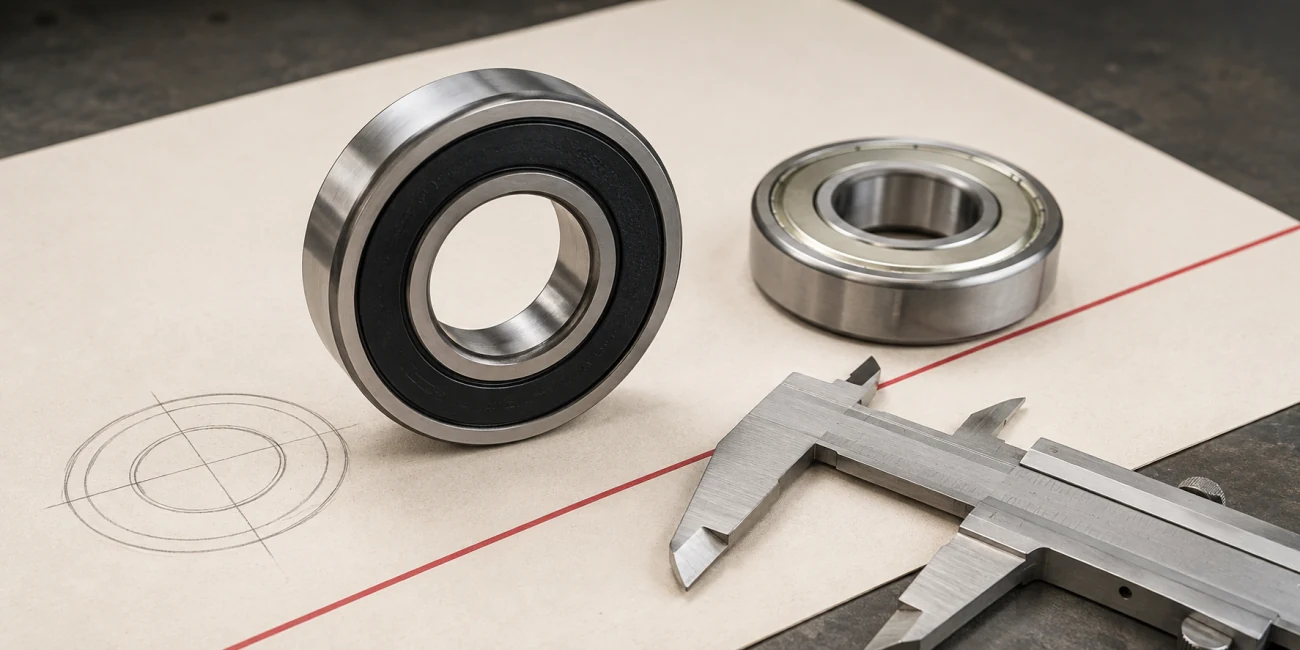
The last two digits of a bearing number give you the bore size. For codes 04 and above, multiply by 5 to get the bore in millimetres — so a 6204 has a 20 mm bore. Codes 00 to 03 are fixed exceptions. Here is the full ladder.
Bore code to bore size (mm)
| Bore code | Bore (mm) | Example number |
|---|---|---|
| 00 | 10 | 6200, 6300 |
| 01 | 12 | 6201, 6301 |
| 02 | 15 | 6202, 6302 |
| 03 | 17 | 6203, 6303 |
| 04 | 20 | 6204, 6304 |
| 05 | 25 | 6205, 6305 |
| 06 | 30 | 6206, 6306 |
| 07 | 35 | 6207, 6307 |
| 08 | 40 | 6208, 6308 |
| 09 | 45 | 6209, 6309 |
| 10 | 50 | 6210, 6310 |
| 11 | 55 | 6211, 6311 |
| 12 | 60 | 6212, 6312 |
| 13 | 65 | 6213, 6313 |
| 14 | 70 | 6214, 6314 |
| 15 | 75 | 6215, 6315 |
| 16 | 80 | 6216, 6316 |
The rule holds from 04 upward: code × 5 = bore in mm. Bores below 10 mm, and very large bores, use a different notation — if a code does not fit this pattern, read the manufacturer's datasheet rather than assume.
How to read the rest of the number
Taking 6204-2RS apart, digit by digit:
| Part | Means | In this example |
|---|---|---|
| 6 | Bearing type | Single-row deep groove ball bearing — the most common type |
| 2 | Dimension series | Sets the outside diameter and width for that bore, and so the load capacity |
| 04 | Bore code | 20 mm bore |
| 2RS | Seal or shield suffix | Rubber contact seal on both sides |
The dimension series is why a 6204 and a 6304 both have a 20 mm bore but are not interchangeable: the 6304 belongs to the heavier series, with a larger outside diameter and a higher load rating. Always check the outside diameter and width, not just the bore.
Seal and shield suffixes
| Suffix | Meaning | Use it when |
|---|---|---|
| Open (no suffix) | No seal or shield | The housing is sealed, or the bearing is oil-lubricated |
| Z / ZZ | Metal shield, one side / both sides | Keeping out larger debris; runs cooler than a contact seal |
| RS / 2RS | Rubber contact seal, one side / both sides | Dust, splashing or humidity — better sealing, slightly more friction |
| NR | Snap ring groove fitted | The bearing must be located axially in the housing |
| C3 | Radial internal clearance larger than standard | The bearing will run hot and the shaft or housing will expand |
C3 is the one most often misread. It is not a quality grade — it is a clearance class. Fitting a standard-clearance bearing where the machine specified C3 can leave it preloaded once it reaches operating temperature.
What to do when the number has worn off
On old or unbranded machinery the marking is often unreadable. Measure the bearing directly rather than guessing from the equipment's age or origin. Three dimensions identify it:
| Measure | Why it matters |
|---|---|
| Bore (inner diameter) | Must match the shaft — there is no "close enough" with a bearing fit |
| Outside diameter | Must match the housing bore |
| Width | Separates series that share a bore and outside diameter |
With those three numbers a supplier can identify the bearing even when no code is legible.
Before you order
Confirm bore, outside diameter and width together; check whether the original was sealed, shielded or open; and check whether the machine called for a clearance class such as C3. Getting the bore right but the series wrong is the most common reason a replacement will not seat.
Browse bearings and bearing accessories, including flange bearings and seal rings, on Tools Tribe.
Recent Posts