

Hand Tools vs Power Tools: What an Indian Workshop Actually Needs
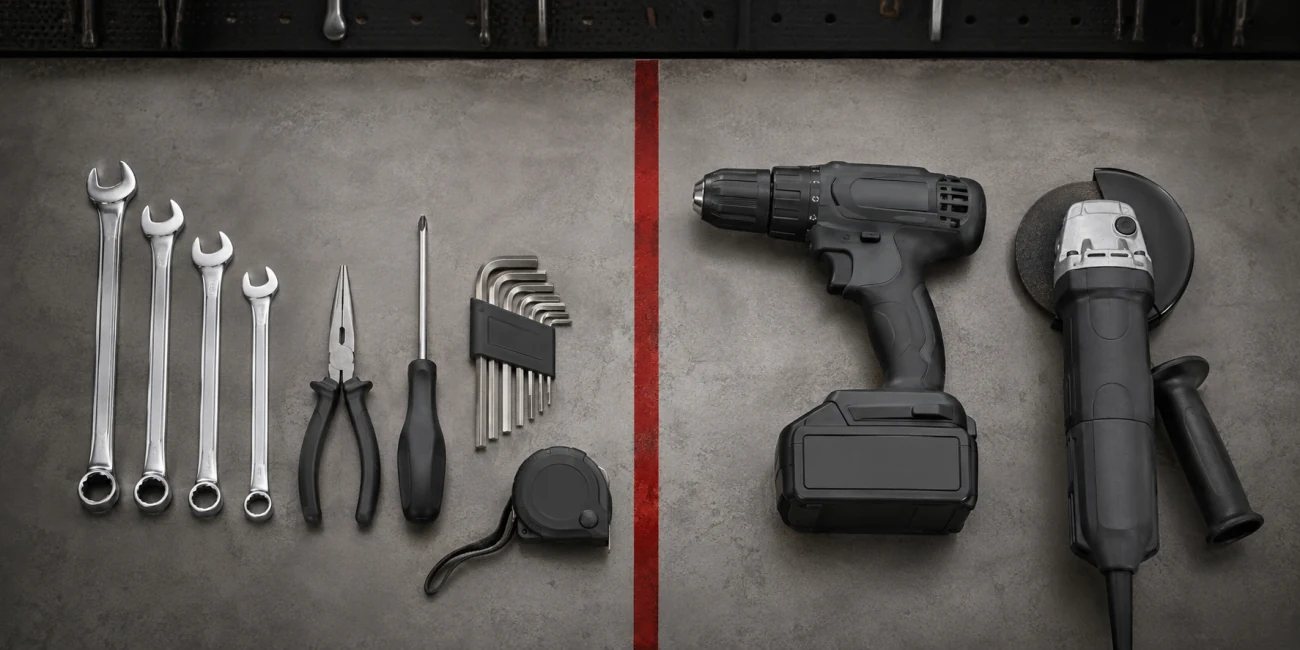
Build the hand-tool base first, then add power tools for the specific repetitive or high-torque jobs your workshop actually does. New workshops routinely reverse that order — and then discover the toolkit still cannot turn a fastener in a confined space. Here is how the jobs split.
Which tool for which job
| Job | Reach for | Why |
|---|---|---|
| Final tightening of a critical fastener | Hand tool | You feel a thread starting to strip; a power tool does not tell you until it has |
| Driving fifty identical screws | Power tool | Repetition is where powered speed pays back |
| Driving five screws | Hand tool | Setup and charge time exceed the saving |
| Breaking loose a seized bolt | Power tool (impact) | Impact energy beats steady torque, and reduces rounding |
| Working in a confined space | Hand tool | A ring spanner or stubby driver fits where a machine body cannot |
| Field service, site work, power cut | Hand tool | No socket, no charge, no problem |
| Drilling steel, grinding, cutting | Power tool | Material removal by hand is slow and inconsistent |
| Work near live circuits or delicate parts | Hand tool | Control matters more than speed |
What each is genuinely better at
| Hand tools | Power tools | |
|---|---|---|
| Feedback and control | High — you feel the joint | Low — torque arrives faster than judgement |
| Speed on repetition | Low | High |
| Power dependency | None | Mains or battery |
| Cost per tool | Lower | Higher |
| Service life | Very long with basic care | Limited by motor, switch and battery |
| Access in tight spots | Good | Limited by body size |
A good-quality spanner or plier set, looked after, outlasts several generations of its cordless equivalent. That is the real argument for spending on hand tools first.
A core hand-tool checklist for a new workshop
| Tool | Typical range | Why it earns its place |
|---|---|---|
| Combination spanner set | 8–24 mm metric | Covers the majority of everyday fasteners |
| Ring spanners | Sizes outside the set | Grips all six flats — far less rounding than an open jaw |
| Socket set with ratchet | 1/2 inch drive | Faster than a spanner wherever there is swing room |
| Adjustable wrench | One or two sizes | Odd and imperial sizes; not for final tightening |
| Pliers | Combination, long-nose, cutting | Gripping, forming and cutting wire |
| Screwdriver set | Flat and Phillips, several sizes | Wrong-size tips are the main cause of chewed screw heads |
| Hex (Allen) key set | Metric | Socket-head screws on nearly all machinery |
| Hammers | Claw plus a soft-face mallet | The soft face is what stops you marking finished work |
| Measuring tools | Tape, steel rule | Every job starts here |
| Bench vice | Sized to the bench | A third hand; makes every other tool safer to use |
Where the money is best spent first
If the budget is limited, buy quality in the tools that take load — spanners, sockets and pliers — and accept mid-range on the rest. A failed spanner rounds a fastener and costs an hour; a mid-range measuring tape costs nothing but a little patience.
On the power-tool side, buy for the job you actually repeat. A workshop that drills every day needs a good drill more than it needs a broad cordless range.
See the full hand tools range, including wrenches and sockets, spanners, pliers and hex and Allen keys, or browse power tools on Tools Tribe.
Recent Posts